
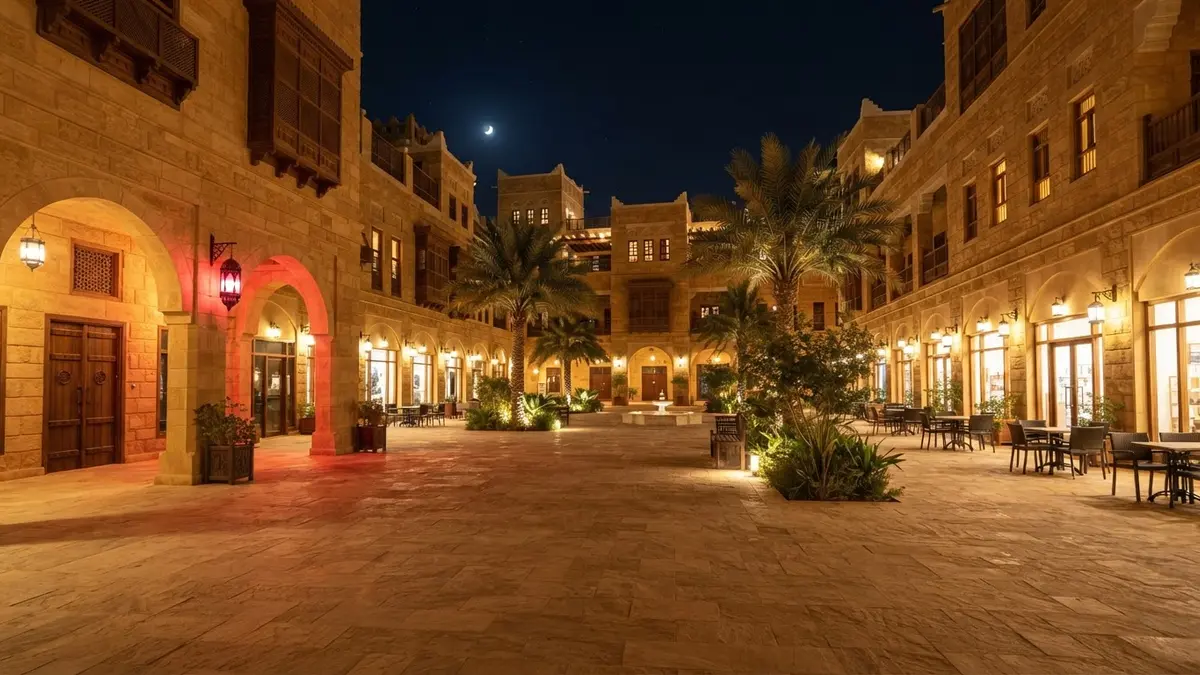
The Evening Shift: Saudi Arabia's Real Estate Reality
In Saudi Arabia, the public realm truly comes alive after sunset. Due to regional climatic conditions, the evening is not merely an extension of the day; it is the primary window for social interaction, community gathering, and commercial transaction. Despite this reality, many master plans and mixed-use developments are still designed primarily through the lens of daytime aesthetics, leaving a significant gap in nocturnal performance.
When a development fails to design for the night-time public realm, it overlooks the peak hours of consumer activity. Successful placemaking in the Kingdom requires a deliberate shift in strategy—treating the post-sunset environment as a distinct operational phase with its own microclimate, lighting requirements, and pedestrian behaviors that differ fundamentally from daytime patterns.
The Cost of Dark and Disconnected Spaces
The commercial cost of an inadequate night-time strategy is measured in lost dwell time and suppressed retail yield. When outdoor lighting is either too harsh or insufficient, and when thermal comfort is ignored, visitors limit their journeys to quick, functional indoor visits. The transition zones between parking, retail storefronts, and outdoor dining areas become cold and uninviting, breaking the pedestrian flow.
Without a cohesive nocturnal design, food and beverage (F&B) operators cannot maximize their outdoor seating capacity, which is often their most profitable square footage. The consequence is a rapid drop-off in footfall after 8:00 PM, precisely when the local market is seeking high-quality leisure experiences that enhance quality of life and drive higher basket values.
Strategic Design Criteria for the Post-Sunset Economy
Designing for the night-time economy requires clear, objective criteria that balance experiential quality with operational efficiency. Developers must evaluate three core pillars: adaptive microclimate management, layered lighting hierarchies, and flexible spatial programming. These elements must work in unison to lower perceived temperatures and create a sense of safety and discovery that encourages longer visits.
Passive cooling techniques, such as strategic wind channeling and thermal mass materials that do not radiate daytime heat back into the evening air, are critical for visitor comfort. Lighting must shift from generic illumination to a curated narrative, using low-glare, warm-spectrum sources that highlight architectural features, guide pedestrian movement, and define intimate social pockets without causing light pollution.
Integrating Light, Landscape, and Commercial Flow
A successful night-time public realm integrates light and landscape to create a seamless, connected commercial journey. Pedestrian pathways should use low-level bollards and integrated step and bench lighting to maintain a clean sky view while ensuring safe footing. This approach prevents visual fatigue and encourages visitors to explore deeper into the commercial district rather than staying on the periphery.
Furthermore, facade lighting must be calibrated to complement, not overpower, the retail storefronts. When architectural lighting is integrated with soft landscape elements—such as uplighting canopy trees and highlighting tranquil water features—it creates a therapeutic, premium environment that naturally elevates the perceived value of the surrounding hospitality and retail offerings, enhancing its destination appeal.
Quantifying the Nocturnal Yield
To justify the investment in high-quality nocturnal design, developers must shift from viewing lighting and landscaping as capital expenses (CAPEX) to recognizing them as operational yield drivers. Extending the comfortable outdoor operating window by even two hours per night directly correlates with increased food and beverage sales and higher retail conversion rates due to a relaxed, captive audience.
Metrics such as average dwell time, evening footfall velocity, and outdoor seating utilization rates should be tracked systematically. A well-designed night-time public realm not only increases immediate tenant sales but also enhances the long-term asset valuation by establishing the development as a preferred lifestyle destination that commands premium rental rates and attracts global brands.
Self-Qualification and Next Steps: Aligning Your Asset for the Night Economy
If your development experiences a sharp decline in outdoor occupancy after sunset, or if your tenants struggle to maintain outdoor seating viability during warm evenings, your asset is leaking significant operational value. Inaction leads to a gradual loss of market share to newer, master-planned districts that treat the night economy as a core design pillar of their attraction strategy.
At Asred, we help Saudi developers and institutional investors diagnose and correct these spatial inefficiencies. We invite you to contact our team for a targeted Nocturnal Spatial Audit of your existing or pipeline developments. Together, we will analyze your asset's evening microclimate, lighting hierarchy, and pedestrian flow to unlock hidden commercial yield and transform your public realm into a high-performing evening destination.