
The Commercial Tension: Aesthetic Premium vs. Operational Realities
In the rapidly evolving Saudi real estate market, the public realm and landscape design play a pivotal role in driving asset valuation, accelerating absorption rates, and commanding premium pricing. Today’s buyers and tenants demand vibrant, walkable environments that enhance well-being and offer thermal comfort. However, developers frequently fall into the trap of importing Western landscape typologies characterized by expansive turfgrass and exotic species, which escalates operational expenditure (OPEX) to unsustainable levels that erode long-term profitability.
Conversely, arbitrary cost-cutting measures—such as replacing green infrastructure with unshaded gravel or excessive hardscaping—directly degrade "place value." This visual and environmental decline diminishes the development's appeal and depresses asset valuation. The true challenge for Saudi real estate leaders is not choosing between aesthetic premium and financial efficiency, but adopting an engineering-led methodology that integrates smart design with local ecological identity to achieve both.
The Hidden Cost of Conventional Greenery in Arid Climates
Conventional turfgrass and exotic flora rely on vast quantities of sweet or treated sewage effluent (TSE) water, a resource facing rising tariffs and high demand across the Kingdom. Beyond water procurement, these systems demand continuous maintenance, including mowing, chemical fertilization, pest control, and frequent replanting due to thermal stress. These recurring costs are rarely transparent in the initial capital expenditure (CAPEX) budget, yet they emerge as a massive financial drag once the project transitions to the operational phase.
Furthermore, over-irrigation leads to soil salinization and damages adjacent hardscape and infrastructure due to high humidity and runoff. When developers realize the scale of these operational expenses too late, they often slash maintenance budgets. This turns what was once the development's primary selling point into a dry, unappealing landscape, directly damaging the developer's brand equity and future asset performance.
Redefining the Aesthetic: The Power of Native and Adaptive Flora
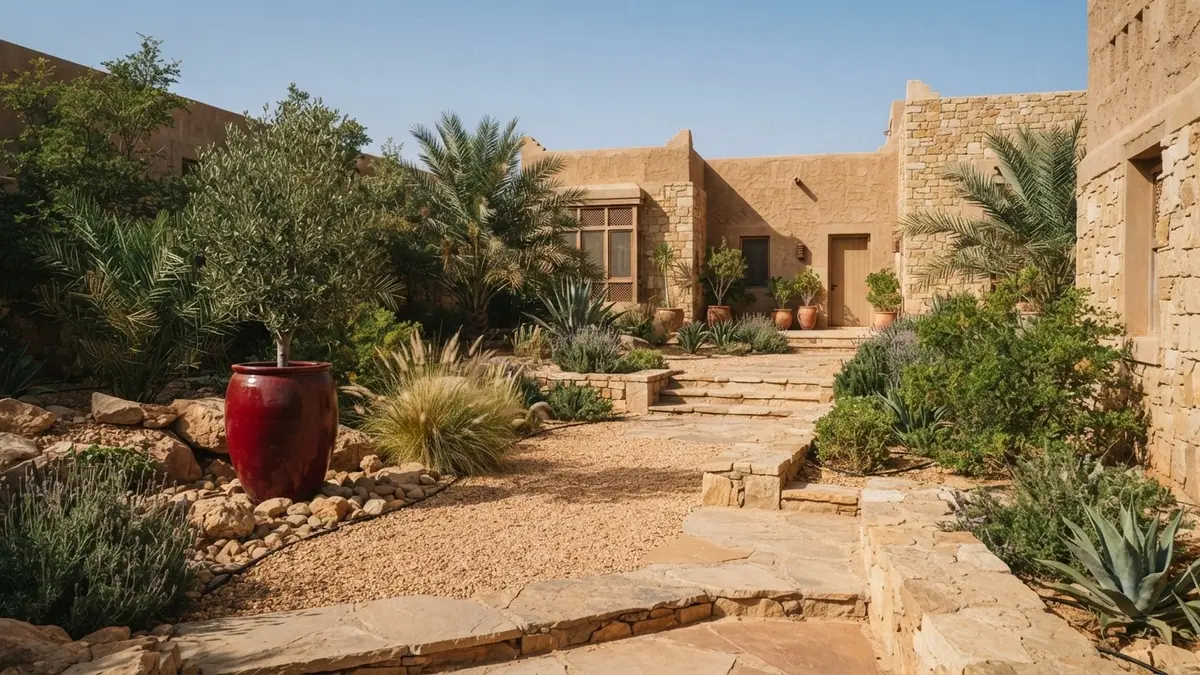
The solution begins with redefining the aesthetic paradigm of luxury in the Saudi context. Utilizing native flora (such as Acacia, Prosopis cineraria, and Haloxylon) and climate-adaptive species does not mean creating a barren desertscape. Instead, it establishes an authentic visual language rooted in the regional identity—whether Najdi, Hijazi, or coastal. These plants possess evolutionary adaptations to thrive with minimal water, high salinity, and extreme heat, requiring fraction of the maintenance of exotic species.
Through strategic grouping and artistic layering, native plants create rich contrasts in color, texture, and scale. This approach, integrated into smart xeriscaping, reduces irrigation water demand by 50% to 70% compared to conventional landscapes. Furthermore, native vegetation supports local biodiversity, bringing a natural dynamism and ecological authenticity to the public realm that deeply resonates with modern residents.
Spatial Engineering and Microclimate Design
Water-wise landscaping is not merely a botanical selection process; it is an exercise in spatial engineering and microclimate design. By analyzing wind patterns and solar radiation, designers can position building masses and utilize natural and structural shading to lower ambient temperatures. This microclimate mitigation directly reduces evapotranspiration rates from soil and foliage, significantly increasing irrigation efficiency.
Effective strategies include hydrozoning—grouping plants with similar water requirements. High-water-use zones are restricted to high-impact pedestrian areas like main entrances and central plazas, while peripheral zones utilize zero-irrigation native species. Additionally, the strategic application of organic mulch and local gravel retains soil moisture and suppresses weed growth, eliminating the need for intensive manual weeding and chemical herbicides.
Developer Decision Criteria: Evaluating Landscape ROI
When reviewing landscape master plans, real estate decision-makers must transition from evaluating initial CAPEX to analyzing Life Cycle Costing (LCC) over a 10-to-15-year horizon. A landscape scheme that appears cost-effective during construction can incur catastrophic operational deficits. Evaluation criteria must quantify water consumption per square meter, projected annual maintenance hours, and the integration of sustainable water sources such as on-site greywater recycling.
Investing in smart irrigation systems equipped with soil moisture sensors and real-time weather data, alongside passive rainwater harvesting infrastructure, offers guaranteed financial returns. While these technologies may slightly increase initial CAPEX, they deliver rapid payback periods by slashing water and maintenance bills by up to 60%. This directly improves the asset's Net Operating Income (NOI) and enhances its valuation for institutional investors.
Self-Qualification and Next Steps: Is Your Asset Future-Proof?
If you are managing an existing real estate asset and observing escalating utility bills, or if you are in the master-planning phase of a new development and concerned about OPEX erosion, it is time to re-evaluate your landscape strategy. Continuing with conventional, water-intensive designs under the Kingdom's increasingly strict water regulations and sustainability mandates poses a severe financial and operational risk that will compromise your asset's market positioning.
At Asred, we partner with developers and institutional investors to transform public realms from operational liabilities into high-performing strategic assets. We bridge commercial clarity with advanced spatial design to deliver water-wise, culturally resonant landscapes tailored to the Saudi market. Contact us today to schedule a comprehensive Landscape OPEX and Water Efficiency Audit for your current or pipeline projects, and start designing spaces where commercial value and ecological resilience coexist.