The Structural Shift in Riyadh’s Real Estate: From Build-to-Sell to Build-to-Rent
The real estate sector in Saudi Arabia, particularly in Riyadh, is undergoing a profound structural transformation aligned with the quality-of-life objectives of Vision 2030. This shift has catalyzed the rise of a new demographic segment comprising young professionals and modern families who prioritize flexible, high-quality living solutions over premature homeownership. Consequently, the Build-to-Rent (BTR) model has emerged as a highly resilient investment vehicle, offering institutional investors and developers stable, recurring yields in an increasingly sophisticated market.
However, transitioning successfully to this asset class requires far more than a shift in marketing strategy; it demands a fundamental restructuring of architectural design methodologies. Spatial planning for BTR assets differs fundamentally from traditional Build-to-Sell (BTS) schemes. Because the long-term operational, maintenance, and facility management responsibilities remain with the developer or asset owner, the building's spatial efficiency directly dictates its net operating income (NOI) and long-term market competitiveness.
The Operational Gap: The Risk of Applying BTS Layouts to Rental Assets
The most critical risk facing Saudi developers today is the misapplication of Build-to-Sell (BTS) design paradigms to long-term rental assets. In a BTS model, the developer’s financial exposure largely concludes upon unit handover, incentivizing the minimization of initial Capital Expenditure (CapEx) often at the expense of material durability and maintenance access. When this short-term design philosophy is applied to BTR developments, owners face an immediate and severe escalation in Operational Expenditure (OpEx) due to rapid wear-and-tear and inaccessible utility systems.
This spatial mismatch extends beyond material specifications to encompass poor layout planning, such as the omission of dedicated delivery logistics, service corridors, and efficient waste management paths. Neglecting these operational flows during the schematic design phase inevitably degrades the tenant experience, drives up vacancy rates, and compromises the asset's long-term valuation, rendering it less competitive against purpose-built rental communities.
Engineering Operational Longevity: Material Specification and MEP Access
To ensure operational durability and suppress maintenance costs, the architectural strategy must prioritize "Design for Maintainability." This requires relocating all primary Mechanical, Electrical, and Plumbing (MEP) access panels from inside individual apartments to the public corridors. This spatial adjustment eliminates the need for maintenance personnel to enter private residences, preserving tenant privacy, minimizing scheduling friction, and enabling seamless preventive maintenance without disrupting occupancy.
Furthermore, material specification must be guided by rigorous Life-Cycle Cost (LCC) analysis rather than upfront procurement costs. Utilizing high-durability floor finishes like polished concrete or commercial-grade porcelain, alongside impact-resistant wall claddings in high-traffic corridors, ensures the property retains its premium aesthetic for years. This strategic selection prevents frequent, disruptive renovations and directly protects the asset's net yield over its operational lifespan.
Maximizing Yield: Balancing Net Rentable Area (NRA) with Shared Amenities
The profitability of a BTR asset is deeply tied to the efficiency ratio between Net Rentable Area (NRA) and Gross Floor Area (GFA). In successful BTR developments, shared amenities like co-working lounges, wellness centers, and social spaces are not treated as non-revenue-generating overhead, but as strategic yield-drivers. By designing flexible, multi-functional spaces that adapt to tenant needs throughout the day, developers can justify premium rental rates and outperform standard market benchmarks.
This approach requires a highly calculated spatial balance; shared amenities must complement, rather than cannibalize, rentable residential square footage. For instance, designing a highly functional lobby integrated with quiet work pods and automated parcel lockers reduces the necessity for large home-office footprints within individual units. This optimization allows for tighter, highly efficient apartment layouts that maximize overall density and rental revenue per square meter.
The Retention Formula: Placemaking and Community Dynamics
Tenant churn is the single most capital-intensive challenge in BTR asset management. The cumulative costs of unit turnover—including refurbishment, re-marketing, and vacancy periods—represent a severe drain on net yields. Strategic placemaking serves as a powerful design countermeasure, creating built environments that foster a deep sense of community and belonging. When tenants feel socially connected to their physical environment and neighbors, their propensity to renew their leases increases dramatically.
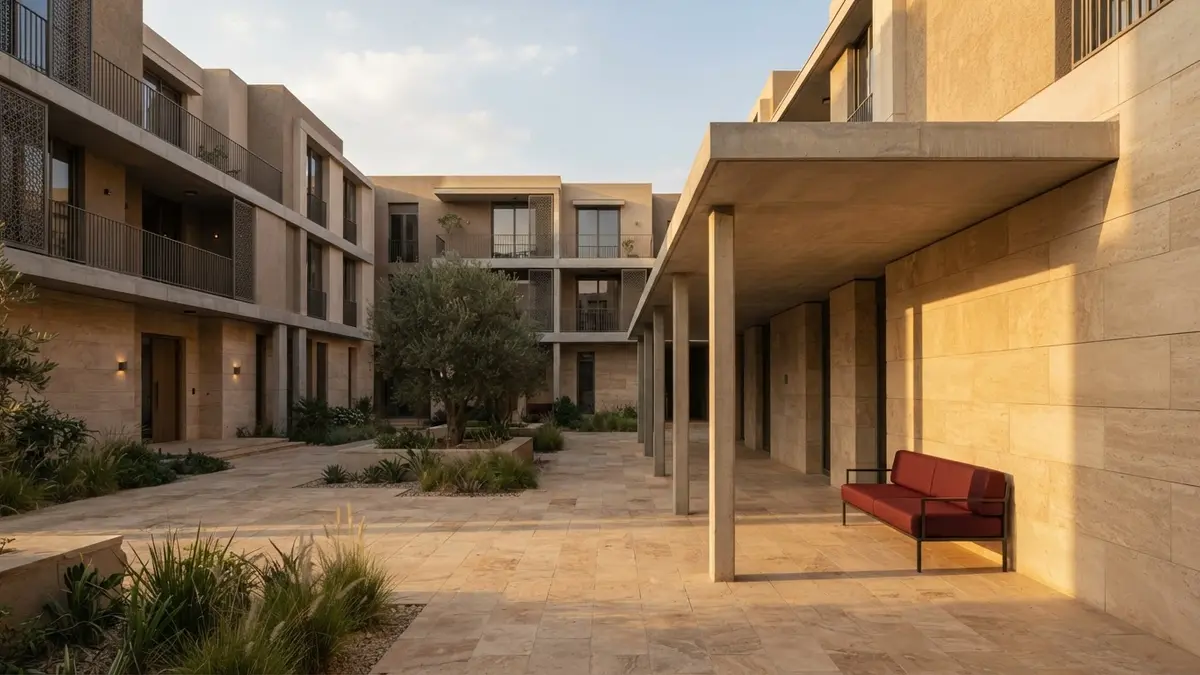
This is achieved by designing interactive public realms, such as shaded courtyards, community event spaces, and pedestrian-friendly green corridors that encourage daily spontaneous interaction. Integrating these culturally contextualized spatial elements, tailored to modern Saudi lifestyle preferences, builds a vibrant, self-sustaining community. This transitions the development from a transient housing block into a long-term home, stabilizing occupancy and securing predictable revenue streams.
Self-Qualification: Protecting Your Asset Before Groundbreak
Developing a residential BTR asset using conventional, sales-oriented design blueprints is a significant financial risk that can permanently impair your yields through inflated operational costs and high tenant turnover. To avoid this costly operational gap, developers and investors must critically evaluate their architectural plans against performance-driven, long-term operational criteria well before breaking ground.
At Asred, we deeply understand the direct correlation between spatial design and financial performance within the Saudi real estate landscape. We partner with developers and institutional investors to translate ambitious visions into high-yielding, durable assets through specialized architectural and placemaking strategies optimized for BTR. Contact us today to schedule a technical consultation and ensure your upcoming development is architecturally engineered for maximum yield and operational efficiency.